November 2026
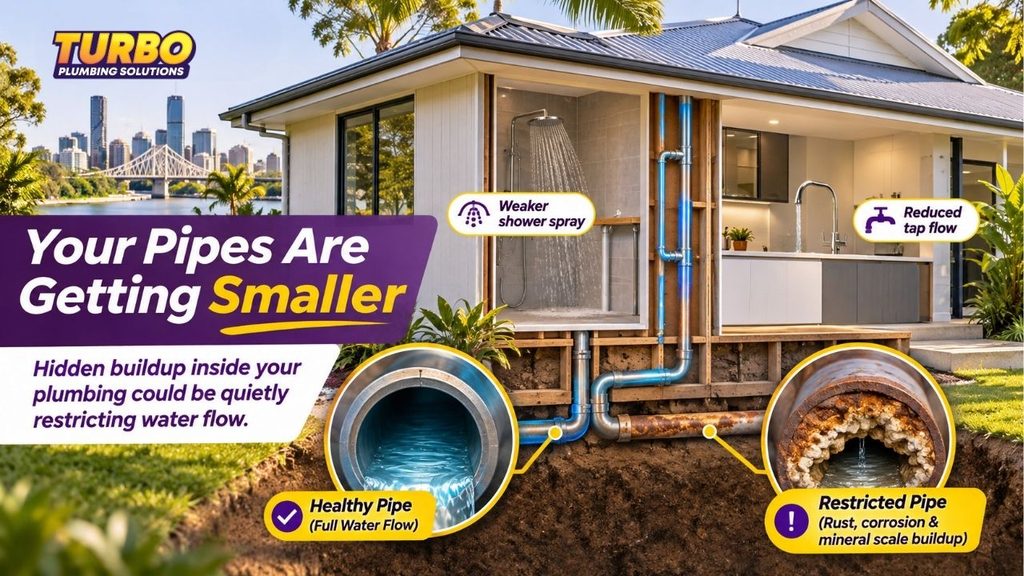
The hidden buildup inside your plumbing that could be quietly restricting water flow throughout your Brisbane home.
Your pipes are still there.
They haven’t moved. They haven’t collapsed. And from the outside, everything might look perfectly normal.
But what if the space inside them is slowly getting smaller?
Not because the pipes themselves are shrinking.
But because something is gradually building up along their internal walls.
Mineral deposits.
Rust.
Corrosion.
Layers of accumulated material that can restrict the space available for water to travel.
And the unsettling part?
This could be happening inside your plumbing for years before you notice anything unusual.
One day, your shower pressure doesn’t feel quite as strong.
Your kitchen tap takes longer to fill the sink.
Or your plumbing starts behaving differently from how it used to.
You might blame the water supply, the showerhead or even the age of your fixtures.
But sometimes, the problem is hiding much deeper.
Inside the pipes themselves.
As Brisbane homeowners prepare for another busy summer, it’s worth understanding a plumbing problem that doesn’t always announce itself with a leak or a blockage.
Because sometimes, what builds up inside your pipes matters just as much as what happens outside them.
1. Wait, How Can a Pipe Actually Get Smaller?
Let’s clear something up first.
In most cases, the pipe itself isn’t physically shrinking.
Instead, deposits can accumulate along its internal surface, reducing the space available for water to flow.
Imagine drinking through a straw.
When the straw is clean, liquid moves through it easily.
Now imagine a layer of material gradually forming around the inside.
The opening becomes narrower.
More resistance develops.
And eventually, moving the same amount of liquid through it becomes more difficult.
Something similar can happen in certain plumbing systems.
Over time, corrosion products, mineral deposits or other materials may accumulate inside pipes.
This is sometimes referred to as internal scaling or tuberculation, depending on the material and process involved.
And while a small amount of buildup might not cause noticeable symptoms, significant deposits can restrict flow.
The pipe may look perfectly fine from the outside while the space inside tells a completely different story.
2. The Rust That’s Growing Inside Older Pipes
One of the most common examples of internal pipe deterioration involves older galvanised steel plumbing.
Galvanised steel pipes were used in many older homes before modern plumbing materials became widespread.
These pipes have a protective zinc coating designed to help resist corrosion.
However, that protection can deteriorate over time.
As the coating wears away, the underlying steel may begin to corrode.
Rust and other corrosion products can develop along the internal pipe walls.
And in some cases, those deposits can become substantial.
What Happens When Rust Builds Up?
Corrosion products may form rough, uneven deposits inside the pipe.
These can restrict the available flow area and create additional resistance as water travels through the system.
Over time, homeowners may notice changes in water delivery.
For example:
- Reduced water flow from certain taps
- Discoloured water after periods of inactivity
- Uneven water performance between fixtures
- Increasing problems with older pipework
However, these symptoms aren’t exclusive to corroded pipes.
Blocked tap aerators, faulty valves, pressure issues and other plumbing problems can produce similar results.
That’s why identifying the actual cause matters.
A weak shower doesn’t automatically mean your pipes are full of rust. But in an older plumbing system, internal corrosion may be worth investigating.
3. Mineral Buildup Can Also Restrict Water Flow
Rust isn’t the only material that can accumulate inside plumbing.
Minerals naturally present in water can sometimes form deposits on internal surfaces.
One familiar example is limescale.
Limescale primarily forms from calcium carbonate and is more commonly associated with hard water.
You may have seen similar deposits around taps, showerheads or inside kettles.
Under suitable conditions, mineral scale can also develop inside plumbing components and water heating equipment.
Does Brisbane Have a Serious Limescale Problem?
This is where local context matters.
Water hardness varies between regions and water sources.
Brisbane’s drinking water is generally not considered extremely hard compared with some other parts of Australia.
That means severe limescale buildup should not automatically be assumed to be a widespread problem in every Brisbane home.
However, mineral deposits can still affect certain fixtures and components, depending on local water conditions, temperature and the age of the equipment.
Hot water systems can be particularly relevant because heating water may encourage some dissolved minerals to form deposits.
The important distinction is that mineral scaling and pipe corrosion are different processes.
They can both affect plumbing performance, but they don’t necessarily occur for the same reasons or require the same solution.
4. Your Hot Water Pipes Might Be Telling a Different Story
Here’s an interesting clue.
What if your cold water pressure seems normal, but the hot water flow has become noticeably weaker?
That difference can help narrow down where a plumbing problem might be occurring.
Hot water systems contain valves, fittings and other components that can become restricted or deteriorate over time.
Depending on the system, sediment, mineral deposits or internal component problems may affect performance.
Older hot water pipework may also experience corrosion or other deterioration.
Warning Signs Worth Noticing
You might experience:
- Strong cold water flow but noticeably weaker hot water flow
- Reduced hot water delivery at several fixtures
- Unusual noises from a hot water system
- Changes in water temperature or consistency
- Discoloured water from hot water taps
These symptoms don’t automatically confirm internal scaling.
For example, a faulty tempering valve, partially closed isolation valve or another restriction could produce similar behaviour.
But they provide useful information when a plumber is investigating the problem.
Sometimes, comparing your hot and cold water performance can reveal where to start looking.
5. The Slow Decline Most Homeowners Don’t Notice
One of the frustrating things about internal pipe buildup is how gradually it can develop.
Imagine moving into a home where the shower works perfectly.
The water flows strongly.
The kitchen sink fills quickly.
Everything feels normal.
A few years later, the shower seems a little weaker.
But it’s such a small difference that you barely notice.
Then another year passes.
The bathroom tap doesn’t flow quite as well as it used to.
You assume it’s simply getting older.
And because the change happened slowly, you never really think of it as a plumbing problem.
Why Gradual Changes Matter
A sudden reduction in water flow usually gets your attention.
But gradual deterioration can be easier to overlook.
In some older plumbing systems, corrosion and internal deposits may progressively increase resistance to water flow.
That doesn’t mean every home experiences this problem.
Modern plumbing materials and properly maintained systems can perform reliably for many years.
However, if you’re living in an older Brisbane property and have noticed a gradual decline in water flow, internal pipe condition is one possibility worth considering.
Especially if multiple fixtures are affected.
6. What Happens When the Inside of a Pipe Becomes Too Restricted?
When significant deposits accumulate inside a water supply pipe, they can interfere with how efficiently water moves through it.
And that can create several noticeable problems.
Reduced Water Flow
A restricted pipe may deliver less water than expected, particularly when multiple fixtures are being used.
You might notice the shower becoming weaker when someone turns on another tap.
Uneven Performance Around the Home
Some fixtures may receive adequate flow while others struggle.
This can happen when restrictions are concentrated in particular sections of pipework.
Discoloured Water
In older corroding metal pipes, rust particles and other deposits may occasionally become disturbed.
This can contribute to brownish or reddish water.
However, discolouration can also originate from the public water supply or other parts of the plumbing system.
If water suddenly becomes discoloured, check for water utility notices and seek appropriate advice before using it for drinking or cooking.
Increased Strain on Plumbing Performance
A restricted water supply can make everyday tasks more frustrating.
Filling a bath takes longer.
Using multiple taps becomes inconvenient.
And appliances that rely on adequate water delivery may not perform as expected.
But remember, low flow is a symptom, not a diagnosis.
The underlying cause still needs to be established.
7. Your Pipes Might Be Corroding Without Getting Smaller
Here’s another important detail.
Not all pipe corrosion results in internal buildup.
Some forms of corrosion gradually remove material from the pipe wall.
Instead of creating a restriction, this can weaken the pipe itself.
Over time, deterioration may contribute to pinhole leaks or other failures.
The type of corrosion depends on factors such as pipe material, water chemistry, temperature, installation conditions and age.
For example, copper pipes can experience certain forms of corrosion under particular conditions.
But that doesn’t mean all copper plumbing is prone to failure or that corrosion is inevitable.
Likewise, modern plastic plumbing materials do not rust in the same way as steel.
Different materials have different strengths, limitations and potential failure mechanisms.
This is why the age and material of your plumbing matter when investigating recurring problems.
8. Could the Problem Be Something Much Simpler?
Before assuming your underground pipes are filled with years of buildup, consider the more common causes of poor water flow.
Sometimes the problem is much closer to the tap.
A clogged aerator can make a kitchen mixer feel weak.
A showerhead with blocked spray openings can reduce the amount of water reaching you.
A partially closed isolation valve may restrict flow to one fixture.
A faulty pressure reducing valve can affect water delivery across a property.
And changes in the public water supply may temporarily affect pressure or water appearance.
How Plumbers Narrow Down the Cause
A plumber may start by checking whether the issue affects one fixture or several.
They may compare hot and cold water performance.
Inspect accessible valves and fittings.
Measure water pressure and flow where appropriate.
And assess the age, material and condition of the plumbing system.
These checks help determine whether the issue is localised or part of a broader water supply problem.
Because replacing pipes without confirming the cause can be an unnecessary and expensive mistake.
9. Can a CCTV Camera See Inside Water Supply Pipes?
We’ve talked a lot about CCTV drain inspections in previous articles.
And they’re excellent tools for investigating certain drainage problems.
But here’s an important distinction.
A standard CCTV drain inspection is not normally the method used to inspect pressurised drinking water pipes.
Drain cameras are generally designed for wastewater and stormwater drainage systems.
Pressurised water supply plumbing requires different diagnostic approaches.
Depending on the suspected problem, plumbers may use pressure testing, flow measurements, leak detection equipment, visual inspection of accessible components and other suitable methods.
In some cases, the condition of removed pipe sections can also help reveal internal corrosion or deposits.
The appropriate investigation depends on the plumbing material, location and symptoms.
That’s why using the right diagnostic method is just as important as having the right equipment.
10. Can You Clean the Buildup Out of Your Pipes?
This is where homeowners need to be careful.
It might sound logical to simply flush or dissolve whatever is inside the pipe.
But internal corrosion and mineral deposits aren’t always straightforward to remove.
The appropriate solution depends on what the buildup is, how severe it has become and the condition of the pipe itself.
When Cleaning or Component Replacement May Help
If the restriction is limited to a tap aerator, showerhead, valve or another accessible component, cleaning or replacing that component may resolve the problem.
Certain hot water system issues may also be addressed through appropriate servicing.
When Pipe Replacement May Be Necessary
If older galvanised pipes are severely corroded internally, replacing affected sections may be more practical than attempting to clean them.
This is particularly true when the pipe walls have deteriorated or the system is experiencing recurring problems.
Why DIY Chemical Cleaning Is a Bad Idea
Pouring household chemicals into drinking water pipes is not a safe or appropriate way to address suspected internal buildup.
Unsuitable chemicals can damage plumbing components, create contamination risks and fail to resolve the actual cause.
Any treatment or repair involving potable water plumbing should use approved methods and suitable materials.
The goal isn’t simply to remove deposits. It’s to restore safe, reliable water delivery.
11. How Can Brisbane Homeowners Protect Their Plumbing?
Not every form of internal pipe deterioration can be prevented.
Plumbing materials age, water conditions vary and older installations may eventually need attention.
However, homeowners can take practical steps to recognise problems earlier.
Pay Attention to Changes in Water Flow
If a tap or shower becomes noticeably weaker, don’t automatically assume it’s normal.
Check whether the problem affects one fixture or multiple areas of the home.
Watch for Discoloured Water
Occasional changes in water appearance can have several causes.
But recurring discolouration, particularly alongside other plumbing symptoms, deserves investigation.
Know the Age of Your Plumbing
If you live in an older property, understanding what materials were used can help when planning maintenance or renovations.
Have Recurring Pressure Problems Investigated
If water flow continues to deteriorate or multiple fixtures are affected, professional pressure and flow testing may help identify the cause.
Don’t Ignore Small Leaks
Aging plumbing systems can develop multiple problems over time.
Addressing leaks promptly can help reduce the risk of water damage.
And if you’re planning a major bathroom or kitchen renovation, it may be a good opportunity to assess the condition of older accessible pipework before everything is covered again.
12. The Real Problem Is What You Can’t See
Here’s what makes internal pipe buildup different from many other plumbing problems.
A leaking tap gives you a drip.
A blocked toilet makes itself obvious.
A burst pipe usually demands immediate attention.
But corrosion and internal deposits can develop quietly.
There’s no dramatic warning.
No obvious puddle.
No strange noise coming from the wall.
Just a plumbing system that may slowly become less efficient.
Until one day, you realise your shower isn’t what it used to be.
Or your taps aren’t delivering water the way they should.
And suddenly, you’re wondering how long the problem has been developing.
The important thing is not to assume every change means something serious is happening.
Sometimes the solution is as simple as cleaning a showerhead.
Other times, the condition of older pipework deserves a closer look.
Because the most expensive plumbing mistake isn’t always ignoring a visible problem. Sometimes, it’s replacing the wrong thing because nobody investigated what was actually happening.
Your Pipes Don’t Have to Be Blocked to Have a Problem
When homeowners think about blocked pipes, they usually imagine something stuck inside.
Tree roots.
Food scraps.
Hair.
Foreign objects.
But in some plumbing systems, the restriction develops gradually along the pipe walls themselves.
Corrosion products and mineral deposits can reduce the space available for water to flow.
And unlike a typical drain blockage, the problem may not be resolved with ordinary drain cleaning equipment.
The solution starts with identifying the pipe material, understanding the symptoms and determining what is actually restricting the water.
So if your shower pressure has been getting weaker, your taps aren’t performing as they should or you’re concerned about aging plumbing, don’t simply assume it’s something you have to live with.
There may be a reason.
And there may be a practical solution.
Is Your Home’s Water Flow Getting Weaker? Let Turbo Investigate.
You shouldn’t have to guess why your plumbing isn’t performing the way it used to.
At Turbo Plumbing Solutions, we help Brisbane Northside homeowners investigate water pressure problems, leaks, aging plumbing and other issues affecting their water supply.
Whether you’re dealing with reduced water flow, recurring plumbing problems or concerns about older pipework, our team can assess the situation and recommend suitable next steps.
We proudly service Albany Creek, Brendale, Eatons Hill, Strathpine, Warner, North Lakes, Bridgeman Downs, Griffin, Aspley, Everton Park and surrounding Brisbane Northside suburbs.
Because just because your pipes look fine from the outside doesn’t mean everything is flowing smoothly on the inside.Don’t wait until an unpleasant smell becomes a bigger plumbing problem.
Contact Turbo Plumbing Solutions and get your drains checked.
🌐 https://www.turboplumbingsolutions.com.au/book/
☎️ 07 3130 5976
Access our All-in-One Smartlink: https://t.mtrbio.com/turbo-plumbing-solutions
Visit our all-new TPS Portal:
Portal.turboplumbingsolutions.com.au