September 2026
The storm rolls through.
The rain stops.
The sun comes back out.
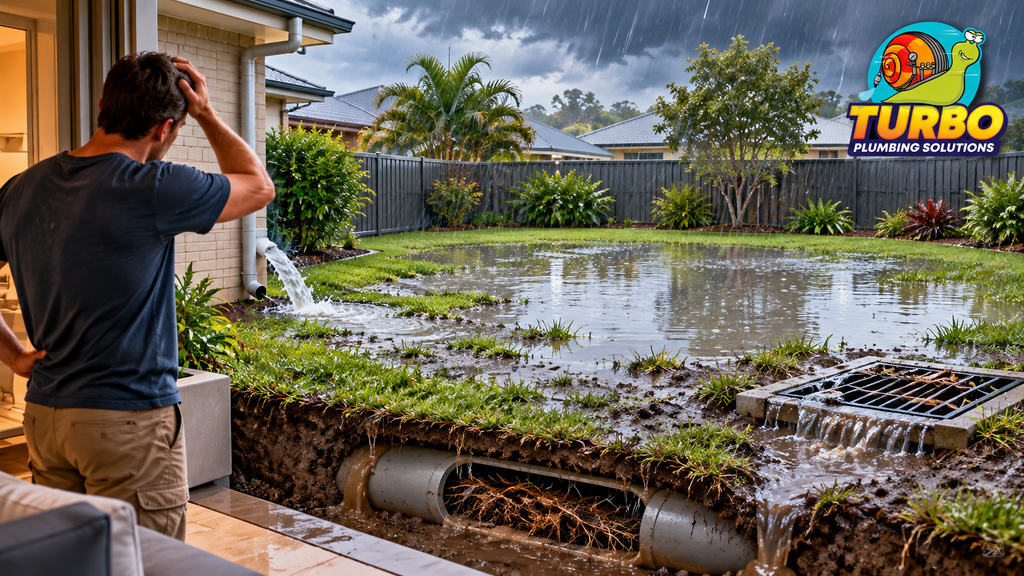
But your backyard?
Still underwater.
If you find yourself staring out the window after every Brisbane downpour wondering why the same section of your yard turns into a miniature swimming pool, there is probably a reason.
And no, buying another bag of soil and filling the puddle again might not be the answer.
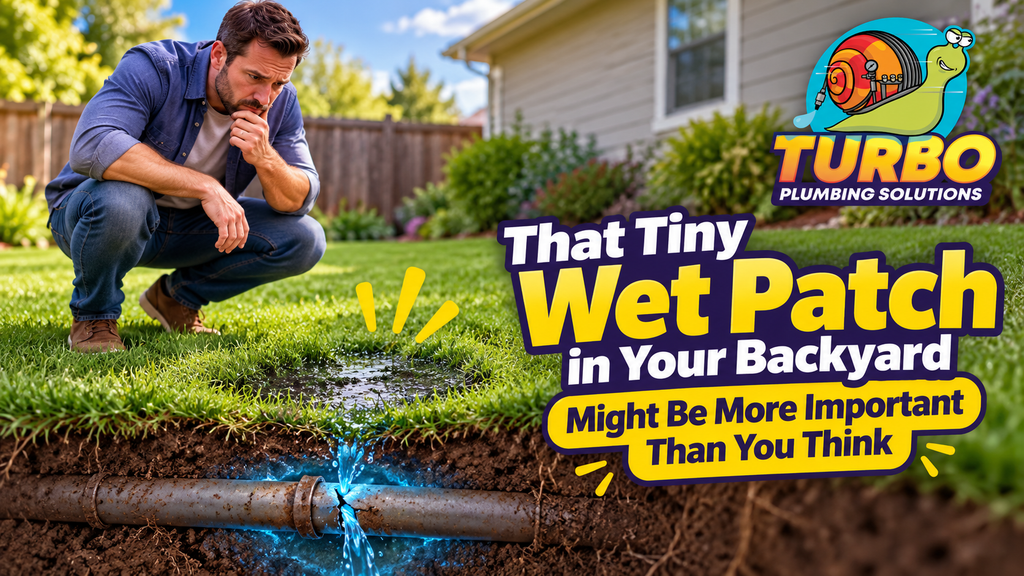
Recurring backyard flooding can be a sign that water simply does not have an effective way to leave your property.
The important question is:
Where is all that water supposed to go?
Because until you answer that, you are really just treating the puddle.
Not the problem.
First, Why Does Your Backyard Keep Flooding?
Every property handles rain differently.
The slope of the land, soil type, landscaping, roof area, paving, stormwater pipes and surrounding properties can all influence where water travels during heavy rain.
Sometimes the explanation is surprisingly simple.
Your yard might have a low point where water naturally collects.
The ground might slope towards the house instead of away from it.
The soil may drain slowly.
Or your stormwater system might not be moving water away quickly enough.
The problem usually becomes obvious during heavy rain because suddenly your drainage system needs to handle a large amount of water in a short period.
That is when the weaknesses start showing.
Your Backyard Might Have a Favourite Puddle
Have you noticed that water always appears in exactly the same spot?
That is a clue.
Water naturally follows the easiest path available.
If there is a low section in the lawn, water can collect there and remain long after the rain has stopped.
Simply filling that spot without understanding how water moves across the rest of the property may only move the problem somewhere else.
Good backyard drainage is not about making water disappear.
It is about controlling where it goes.
Your Soil Could Be Part of the Problem
Some soil absorbs water more effectively than others.
Compacted or poorly draining soil can leave water sitting close to the surface instead of allowing it to soak away efficiently.
You might notice:
Soggy grass long after rain
Muddy areas that never seem to dry
Water sitting around garden beds
Grass struggling in constantly wet areas
Soft ground underfoot
But soil is only one part of the picture.
If large amounts of water are being directed into the same section of your backyard, even good soil can struggle.
Which brings us to something homeowners often forget.
Look Up Before You Look Down
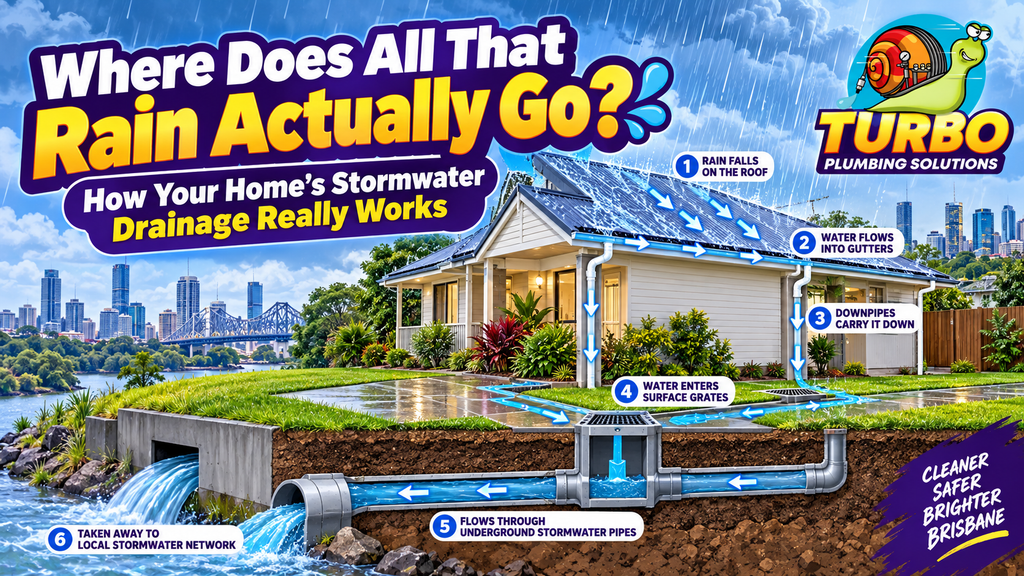
Your backyard drainage problem might actually start on the roof.
Think about how much water lands on your home during a serious Brisbane downpour.
Your gutters collect it.
Your downpipes carry it down.
Then what?
If downpipes are not properly connected or the stormwater system they feed into is restricted, a huge amount of roof water may end up contributing to the problem around your home.
The backyard might be where you see the water.
But it might not be where the problem begins.
That is why looking at the whole stormwater journey matters.
Concrete Changes Everything
Modern backyards contain plenty of surfaces that do not absorb much water.
Driveways.
Patios.
Paths.
Sheds.
Pool surrounds.
Outdoor entertaining areas.
When rain lands on these surfaces, it becomes runoff.
And that runoff needs somewhere to go.
The more hard surfaces around a property, the more important it becomes to understand how water is being collected and directed.
Otherwise, several different areas can all send water towards the same unfortunate patch of lawn.
What If the Problem Is Underground?
This is where backyard drainage gets interesting.
Sometimes everything above ground looks reasonably normal.
The real problem is inside the stormwater pipe.
Leaves, sediment and debris can restrict drainage.
Tree roots may enter damaged pipework.
Sections of pipe can deteriorate or become damaged.
When the pipe cannot move water effectively, the system can begin backing up during heavy rain.
From the surface, it might simply look like your backyard has poor drainage.
But underneath the ground, there could be a completely different story.
This Is Where a CCTV Drain Inspection Can Help
Guessing where an underground drainage problem is located can quickly become expensive.
That is why CCTV drain inspections can be useful when a stormwater pipe is suspected.
A drain camera allows a plumber to inspect inside the pipe and look for restrictions, tree root intrusion, damage and other problems that could be affecting water flow.
If a blockage is identified, professional drain cleaning equipment may be used depending on the condition and cause.
The goal is simple.
Find the actual problem before deciding on the solution.
Because digging up half the backyard only to discover the problem was somewhere else is nobody’s idea of a good weekend.
So What Can Actually Improve Backyard Drainage?
There is no single solution that works for every Brisbane property.
That is important.
One home might simply have a blocked stormwater pipe.
Another might need better surface drainage.
Another may have water collecting in a low section of the yard.
Depending on the property and the cause, drainage solutions may involve things such as:
Stormwater pits
Surface drains
Improved stormwater pipework
Appropriate subsoil drainage
Swales that help guide surface water
Correcting how runoff is directed
Clearing blocked stormwater pipes
Repairing damaged underground drainage
Improving connections from downpipes
The right solution depends on where the water is coming from, why it is collecting and where it can legally be discharged.
That is why diagnosis should come before installation.
A Bigger Drain Is Not Automatically the Answer
When homeowners see flooding, the natural reaction is:
We need more drainage.
Maybe.
But not always.
Imagine installing additional drainage that connects into a stormwater pipe that is already partially blocked.
You have created another way for water to reach the same problem.
Or imagine installing a drain in the lowest part of the yard without first checking whether there is sufficient fall to move that water away.
Drainage needs to work as a complete system.
Collection is only the first step.
The water still needs somewhere appropriate to go.
Don’t Accidentally Send the Problem Next Door
This is another important consideration.
Stormwater cannot simply be redirected wherever it is most convenient.
Sending large amounts of runoff towards a neighbouring property can create an entirely new problem.
Your property’s stormwater needs to be managed appropriately and directed towards a suitable discharge point.
That is one reason significant backyard drainage work should be properly assessed rather than improvised during the next wet weekend.
Watch Your Backyard During the Next Downpour
You can learn a surprising amount simply by watching what happens when it rains.
Not during dangerous weather, of course.
But when conditions are safe, look at how water behaves around the property.
Where does water collect first?
Which direction does it travel?
Are your gutters overflowing?
Are stormwater grates disappearing underwater?
Does one section of the lawn stay wet much longer than everything else?
Is water moving towards the house?
Does water appear to come back through a drain?
These observations can provide useful clues.
Take photos or videos too.
By the time a plumber arrives, the rain may be gone and the yard may look completely different.
Seeing what actually happened during the rainfall can help explain the problem.
When Should You Stop Blaming the Rain?
A little surface water during exceptionally heavy rainfall does not automatically mean something is wrong.
But recurring flooding deserves attention.
Especially when:
The same area floods repeatedly
Water remains for a long time after rain
Stormwater pits overflow regularly
Water moves towards the house
Your yard becomes unusually soggy
You notice erosion
Outdoor drains are slow to clear
Flooding seems to be getting worse
At that point, saying “Brisbane just gets a lot of rain” might be missing the bigger picture.
The rain may simply be revealing a drainage problem that was already there.
Your Backyard Shouldn’t Need Gumboots Every Time It Rains
Good backyard drainage is something most homeowners never think about.
Because when it works, there is not much to see.
Rain falls.
Water moves away.
The yard dries.
Life continues.
It is when the same puddle keeps coming back that your property starts asking for attention.
As Brisbane heads further into the warmer months and storm season approaches, now is a good time to understand how water actually moves around your property.
Do not wait until you are standing at the back door during the next downpour watching the water get closer.
Find out why it is happening first.
Turbo Plumbing Solutions proudly services Albany Creek, Brendale, Eatons Hill, Strathpine, Warner, North Lakes, Bridgeman Downs, Griffin, Aspley, Everton Park and surrounding Brisbane Northside suburbs.
If your backyard regularly floods, your stormwater drains struggle during heavy rain or the same soggy areas keep returning, we can help investigate what is happening above and below ground.
For your Plumbing needs:
🌐 https://www.turboplumbingsolutions.com.au/book/
☎️ 07 3130 5976
Access our All-in-One Smartlink: https://t.mtrbio.com/turbo-plumbing-solutions
Visit our all-new TPS Portal:
Portal.turboplumbingsolutions.com.au