September 2026
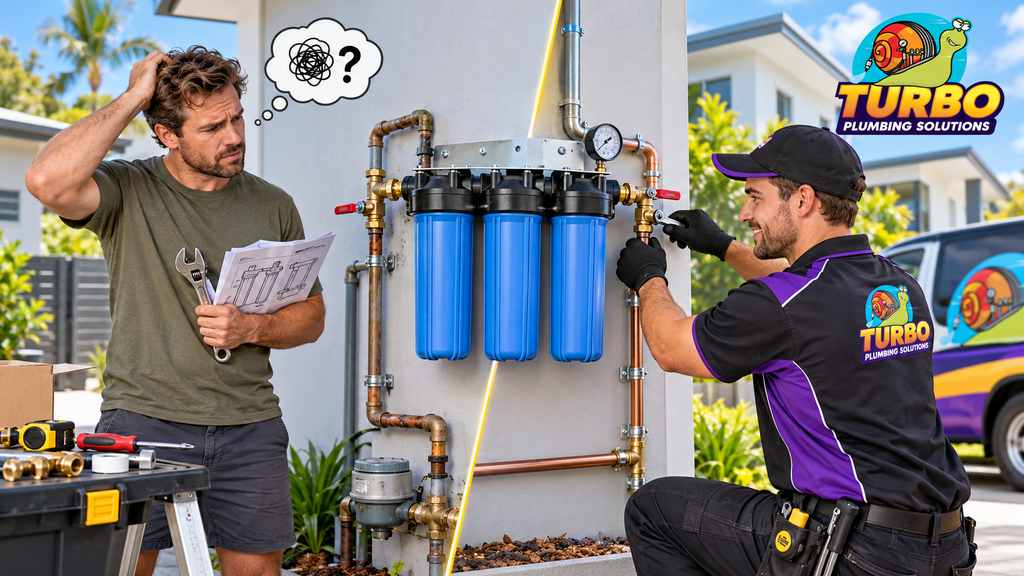
You have chosen the filter.
You have watched a few installation videos.
You have looked at the pipes near the water meter and thought:
How hard could it really be?
That is usually where the DIY temptation begins.
Water filtration is becoming an increasingly interesting upgrade for homeowners who want greater control over the water they use for drinking, cooking, showering and washing.
And when it comes to a simple filter replacement, some jobs really can be straightforward.
But installing a whole house filtration system is a very different conversation.
Before you start cutting into pipes on Saturday morning, there are a few things worth knowing.
First, What Does a Whole House Water Filter Actually Do?
Unlike a small filter attached to a kitchen tap or sitting underneath the sink, a whole house filtration system is designed to treat water as it enters the property.
That means filtered water can potentially be supplied throughout the home.
Kitchen.
Bathrooms.
Showers.
Laundry.
Outdoor taps, depending on how the system is configured.
Different filtration systems are designed for different purposes and may use multiple filtration stages.
The important part is choosing a system that actually suits the household and then installing it correctly.
Because buying a good filtration system is only half the job.
Installing It Is More Than Connecting Two Pipes
A whole house filtration system needs to become part of your home’s water supply.
That immediately raises a few important questions.
Where should the system be positioned?
Is there enough room to service it later?
How will the existing pipework connect to it?
What is the home’s water pressure?
Will the filtration system affect the available flow?
How will the filters be changed?
Does the system need isolation or bypass arrangements?
What does the manufacturer require?
These details might not be the exciting part of buying a new filtration system.
But they can determine how well that system works once it is installed.
The DIY Option Looks Tempting for One Obvious Reason
Cost.
If you are handy around the house, paying someone to install something you think you can handle yourself can feel unnecessary.
There is also no shortage of videos online making plumbing projects look remarkably simple.
Cut here.
Connect this.
Tighten that.
Turn the water back on.
Done.
Except your home’s main water supply is not exactly the best place for trial and error.
The Leak You Notice Immediately Is Not Always the One to Worry About
If you turn the water back on and a connection sprays across the yard, you know there is a problem.
The more frustrating leak can be much smaller.
A tiny amount of water escaping around a fitting may not look particularly serious.
But plumbing does not only operate for the ten minutes you are standing there watching it.
It operates tomorrow.
Next week.
Next month.
That is why correct connections and testing matter.
A plumbing installation should not just look dry when the job is finished.
It needs to stay that way.
Then There Is Water Pressure
One of the biggest complaints you would have after installing a filtration system is suddenly discovering that your shower does not feel the same.
Filtration naturally creates some resistance as water moves through the system.
The filter type, condition, sizing, household demand and existing water pressure can all influence performance.
Choose or install the wrong setup and you may solve one problem while creating another.
Nobody installs a whole house filter because they want disappointing shower pressure.
A professional installation considers how the filtration system will work with the home’s existing plumbing rather than treating it as a completely separate appliance.
Bigger Is Not Automatically Better
This is where homeowners can easily get caught.
A system with more stages, larger housings or impressive specifications may look like the obvious choice.
But the right filtration system depends on what you actually want it to achieve.
Different households have different priorities.
Some are mainly interested in drinking water.
Others want filtration throughout the property.
Some have large families with several bathrooms operating at once.
Others have much lower water demand.
The goal should not simply be:
Buy the biggest filter available.
It should be:
Choose a system that suits the property, the household and the intended use.
Maintenance Should Be Planned Before Installation
Here is something people often think about too late.
Filters need maintenance.
Cartridges eventually need replacing.
Components may need inspection.
So imagine installing a beautiful filtration system in the tightest possible corner where nobody can comfortably reach it.
It works.
Until the first service.
Good installation considers tomorrow as well as today.
The system should be positioned so routine maintenance can be completed without turning every filter change into a major plumbing exercise.
Depending on the system, isolation and bypass arrangements can also make maintenance much more practical.
That planning is one of the less obvious advantages of professional installation.
What About Queensland Plumbing Rules?
This is where the difference between changing a filter and changing plumbing becomes important.
Queensland allows homeowners to perform a limited range of unregulated plumbing tasks, including replacing a domestic water filter.
However, regulated plumbing work generally needs to be completed by an appropriately licensed plumber.
So replacing an existing filter or cartridge is not necessarily the same thing as installing a new whole house filtration system that requires changes to the property’s water supply pipework.
If the installation involves regulated plumbing work, that is not the part to turn into a weekend experiment.
What Does Professional Installation Actually Give You?
It is easy to think you are simply paying someone to connect the system.
You are really paying for the decisions around the connection too.
A licensed plumber can assess the existing pipework, available installation area, water supply and pressure before determining how the system should be incorporated.
The installation can then be completed with appropriate valves and connections, followed by testing and commissioning according to the system requirements.
And importantly, you have someone who understands the plumbing surrounding the filter.
Because the best filtration unit in the world will not compensate for poor installation.
Don’t Forget the Manufacturer’s Instructions
Before purchasing any filtration system, read the warranty and installation requirements.
Some manufacturers may have specific conditions around installation, operating pressure, servicing and replacement intervals.
Ignoring those requirements can potentially affect performance, longevity or warranty coverage.
That is another reason we recommend choosing the system and installation method together rather than buying something online first and figuring out the plumbing later.
DIY or Professional Installation?
For straightforward maintenance such as replacing an appropriate existing filter cartridge, DIY may be perfectly reasonable when the manufacturer’s instructions allow it.
But when the job requires altering your home’s plumbing, installing new pipework, adding valves or connecting a whole house filtration system into the water supply, that is a different level of work.
This is not about saying homeowners cannot do anything themselves.
It is about knowing where the sensible DIY jobs stop.
There is a big difference between:
Changing the filter.
And:
Changing the plumbing to install the filter.
The Filter Is Only as Good as the Installation
A whole house water filtration system can be a great addition to the right home.
But the shiny filtration unit is only the part you can see.
The pipework.
The pressure.
The positioning.
The valves.
The connections.
The accessibility.
And the quality of the installation all matter too.
So before you turn your next Saturday into a plumbing experiment, make sure you know exactly what the job involves.
Sometimes DIY saves money.
Sometimes the smartest DIY decision is knowing when to call a plumber.
Turbo Plumbing Solutions proudly services Albany Creek, Brendale, Eatons Hill, Strathpine, Warner, North Lakes, Bridgeman Downs, Griffin, Aspley, Everton Park and surrounding Brisbane Northside suburbs.
Thinking about installing a water filtration system in your home?
Talk to Turbo Plumbing Solutions about getting the plumbing side of the installation done properly.
For your Plumbing needs:
🌐 https://www.turboplumbingsolutions.com.au/book/
☎️ 07 3130 5976
Access our All-in-One Smartlink: https://t.mtrbio.com/turbo-plumbing-solutions
Visit our all-new TPS Portal:
Portal.turboplumbingsolutions.com.au